If you plan to update or expand your lighting system in the near future, you should consider double-ended HPS bulbs and reflectors as an alternative to conventional, mogul base HID systems. Double-ended high pressure sodium lamps are superior to traditional, single-ended HPS systems for a couple big reasons.
1) Longer life! The double-ended design reduces harmonic distortion (read: vibration), resulting in less physical wear on lamp components. Double-ended HPS lamps retain over 90% of their output after 10,000 hours of use, allowing you to replace your lamps less frequently. Since double-ended lamps are under fewer physical stresses , they can be run at a much higher frequency, resulting in:
2) More light! Double-ended HPS lamps run more efficiently and produce an abundant about of light in the PAR spectrum – around 2100 micromoles per second!
The double ended design reduces harmonic distortion by stabilizing the lamp on both ends, allowing for electricity to pass through the bulb with a very high frequency. A double ended lamp operates optimally between 100 kHz and 150 kHz, while a conventional HPS operates between 20 kHz and 60 kHz. Frequency of a lamp can be visualized as a strobe effect – that is, how many times per second a lamp goes on and off. (That’s right – even while your lamps are running, they are not producing light 100% of the time. This can be demonstrated with a digital camera – focusing on your light source, you’ll be able to notice horizontal dark lines scrolling vertically, much like misadjusted tracking on a VCR.)
Standard ANSI s52 electronic ballasts can operate some double-ended bulbs, and is in fact recommended by the bulb manufacturer Ushio to run their Hilux Gro Pro-Plus(link below). However, to run a double-ended bulb optimally, a higher frequency output is needed from the ballast. Currently there are only a few high frequency ballasts available on the market, the leader being Gavita.
Gavita, with their commercial-grade, 400v/100kHz-output electronic ballasts, has partnered with Philips to produce a “true” double-ended greenhouse fixture. Philips developed their GreenPower bulb specifically for use with Gavita’s high-output ballast to maximize the potential benefits of the double-ended technology.
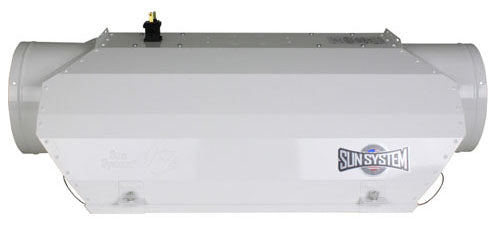
Currently on display at GreenTree is the new Sun System AC/DE Boss (Air Cooled/Double Ended) hood, designed for rooms with lower ceilings and a need to manage heat. Check out the video below for Sunlight Supply’s Comparison test of their AC/DE reflector.
The Ushio Spec sheet can be found here.
Gavita Greenhouse fixtures can be found here.
Stop in and check out our display and we can answer any questions you might have.
--Adam and James
Comments
Hi Terry,
The new double-ended HPS setups are a sort of double-edged sword: they produce substantially more light than a standard HPS system, but along with this intense light comes some intense heat. Due to this extra light and heat, we recommend hanging these a bit higher above your plants than you would a standard HPS system.
Sealed, air-cooled DE HPS fixtures (such as Sunlight Supply’s DE Boss reflector) should start out about 24” above the canopy. If your DE HPS fixture uses a non-sealed hood, where there is no glass between the lamp and plants (such as the Gavita Pro 1000e DE), you’ll want about 36” of space between lamp and canopy. Depending on your individual garden’s specific conditions, you may be able to move your lamp a little closer, or perhaps you’ll have to hang it a little farther away – your plants will tell you what to do. Twisting or distorted growing tips and leaves, excessive yellowing of the growth closest to the lamps, or downward leaf curl are all indicators that your lamps are too close!
As with all HID setups, we also recommend using a circulation fan at canopy level in your garden. This fan should be strong enough to keep your plants’ leaves in gentle motion and dissipate heat between the lamp and canopy; such movement does much to reduce leaf surface temperature. As stated before – with the extra light and heat produced by a powerful DE HPS fixture, ventilation and air circulation become even more important!
If you have any further questions or concerns, don’t hesitate to ask!
Thanks,
The GreenTree Team
How close can you get away with mounting these to the canopy